The problem
Professionals meet useful contacts at conferences, career fairs, and networking events, but the details behind those conversations are easy to lose. A saved contact or LinkedIn connection does not always explain where you met, what you talked about, or why the relationship mattered.
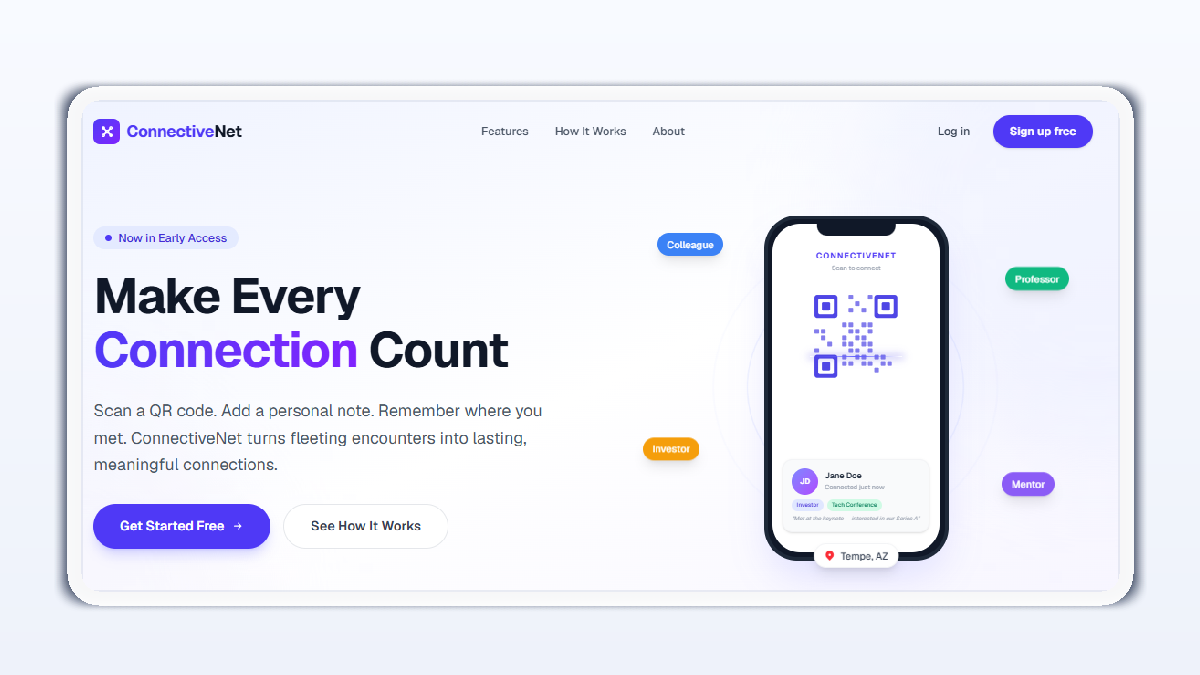
ConnectiveNet was built to preserve that context. Instead of adding another social feed, the platform focuses on organizing professional relationships and helping users follow up with purpose.
What we built
ConnectiveNet is an ASU capstone project and shipped web platform for managing professional connections.
- Profiles, digital business cards, and QR codes for exchanging contact information quickly.
- Connection tools for notes, tags, categories, search, and follow-up context.
- Event and institution pages for tying relationships back to where they started.
- A web dashboard that brings the main user flow together.
- Web messaging features including 1:1 messaging, message requests, and group invites.
The result is a focused networking tool for remembering the people, conversations, and next steps behind each connection.
My contributions
I worked as a Software Engineering Capstone Developer on a three-person team. My main contributions were backend planning, application architecture, and keeping the product organized enough for parallel development.
- Helped design backend systems for profiles, connections, events, institutions, and conversations.
- Worked on the application structure so the web app and future mobile app could share the same backend contract.
- Contributed to planning around conversations, frontend/mobile flows, and reusable UI direction.
- Participated in Scrum ceremonies including sprint planning, stand-ups, reviews, and regular team coordination.
- Helped turn a large product idea into smaller epics that could actually be shipped during the capstone timeline.
This project pushed me to think beyond individual features. A lot of the work was about making good team decisions: what to build first, where responsibilities should live, and how to keep the product moving without letting scope get out of hand.
How we approached it
The team used a decoupled architecture: a Django REST backend, a Next.js web app, and a shared API contract intended to support a future Expo mobile app.
We split the backend into clear domains:
usersconnectionsconversationseventsinstitutions
That structure helped us divide work across the team while keeping the product connected. It also made the project easier to reason about when we were planning features, reviewing progress, and adjusting scope.
What I learned
ConnectiveNet taught me how important communication is on a real software team. The technical choices mattered, but the bigger lesson was learning how to plan around dependencies, document decisions, and keep everyone aligned through sprints.
I also learned how valuable a clear API contract can be. Once the backend responsibilities and data shapes were agreed on, frontend and mobile planning became much easier.
The biggest lesson was scope control. Features like AI follow-up suggestions, GPS proximity, real-time messaging, and mobile support are exciting, but the team had to prioritize the core workflow first: create a profile, make connections, organize them, and follow up with context.
Tech stack
- Backend: Django, Django REST Framework, PostgreSQL
- Frontend: React, Next.js, Tailwind CSS
- Features: QR codes, profiles, connections, events, institutions, messaging
- Workflow: GitHub, Jira, Scrum, sprint planning, stand-ups, team reviews